Alces alces shirasi (subspecies found in Colorado)
Habitat/feeding: Typically found near wetlands, rivers and lakes in areas that include willows with other riparian shrubs such as alder and birch, and forests of aspen, spruce, fir or lodgepole. During summer, eat both submerged and emergent aquatic plants – grasses, sedges, and mosses. In winter, eat twigs of willows and readily browse species of gooseberry, buffaloberry and aspen. Habitat usually in wetter forested areas with seasonal snow cover. Succession from fire and other disturbances helps maintain habitats, producing abundant new growth of preferred herbaceous vegetation. Reclusive in nature and prefer to stay close to home range; will travel long distances if needed to find fresh habitat.
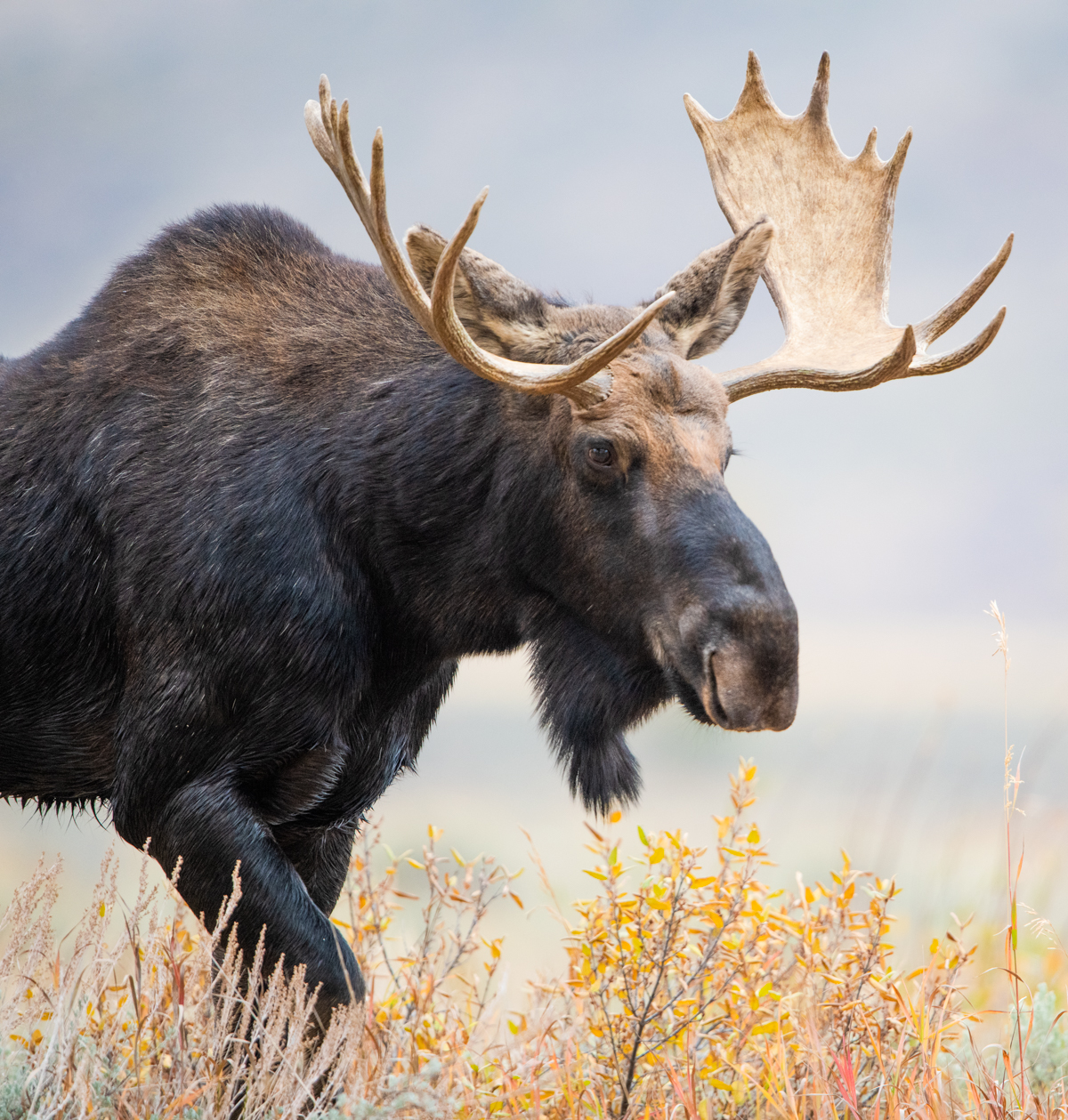
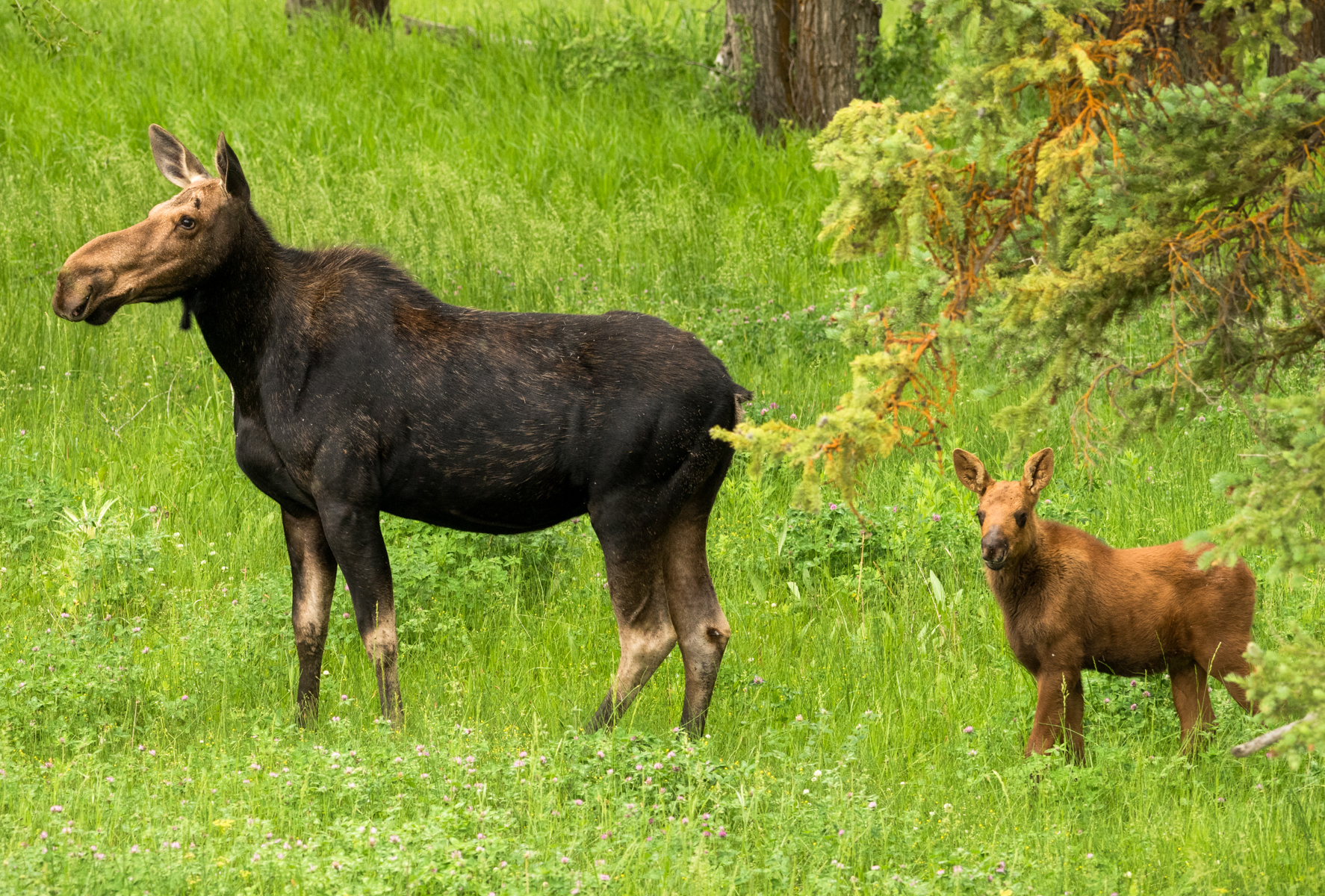
Field ID Traits: No mistaking this distinctive cervid (Deer Family). Although subspecies in Alaska and Canada are larger, Colorado’s subspecies shirasi can still be 6 ft (1.82 m) tall at the shoulders, run 35 miles per hour and weigh up to 1,000 pounds. Hair is long, coarse, and stiff, longest in shoulder and neck areas; dark brown, black, or maybe reddish, contrasting with pale legs; winter coat is grayer; calves are reddish or rusty-colored and lack white spots seen in other deer family members. Their very large head with big erect ears, broad muzzle, and heavy bulbous nose looms above a long, sloping back resulting from longer front legs in comparison to shorter hind legs; very inconspicuous tail. Adult male’s immense, flat, palm-shaped antlers spread to the side and then backward from the head; first visible during late winter, growing throughout spring and summer; covered with “velvet,” a blood-filled, soft, finely haired, thin skin. Antlers harden during late summer and fall after moose rub this velvet off against shrubs and trees, then remain through rutting season before being shed during early winter. Key field mark: obvious fold of hairy skin, called a dewlap, dangling from their throat like a fleshy raindrop.
Tracking notes: Tracks very similar to elk and deer, but moose are much larger at up to 5-7 in (approx. 17-18 cm) in length and up to 4 ft (1.2 m) apart when only walking. Tracks of young moose often confused with deer or elk, so consider habitat and search for adult moose tracks nearby. Each of their feet has 4 hooves, two being very reduced in size – as well as elevated – and referred to as dewclaws. Moose are heavy so dewclaws may show at the rear of their large track, especially in mud or snow. Moose vs elk or deer tracks more likely in wetland habitats.
Reproduction: Rut, when bulls spar aggressively with each other as they search for mates, begins early September. Females are attracted by rutting pits pawed into the ground by bulls and then filled with urine; bulls rub this urine-soaked mud into their dewlap to capitalize on the smell. Cows use calls to attract males. Gestation is 8 months. Born late May-June, calves weigh 22-35 pounds, are tan (not spotted), and grow quickly; twins not uncommon if good food supply ex. Remain with mother for survival in winter but are driven off just before she births again in spring and establish overlapping ranges.
Natural History:
Colorado’s subspecies of this genus is smaller than those found in Alaska and eastern Siberia, but still feel quite majestic. Moose are built for survival during cold, snowy winters with long skinny legs that can handle deep snow and a low surface to volume ratio, thick skin, and warm coat to hold in the heat. However, they don’t tolerate summer heat well, so swimming is a good strategy to cool off, get rid of possible parasites and hide from biting horse flies. Even 68° F (20° C) can be too warm for moose. Spending so much time in cool ponds could be responsible for their adaption to eat a multitude of both underwater and emergent water plants, and they are the only deer known to close their nostrils and hold their breath underwater for up to 50 seconds – even calves are great swimmers. Interestingly, they can also move each ear and each eye independently.
Being the largest land mammal in North America is an advantage while foraging outside of ponds, especially as they can stand on their hind legs to reach desirable tree branches. Their ability to gallop quickly through deep snow also translates to deep brush in summer. Males can be very aggressive toward humans during the fall rut, and cows are likely to be more aggressive in the spring when they are with young calves. They are especially intolerant of dogs as they view them the same as wolves, meaning having a dog off leash in moose territory could cause a more dangerous encounter. Signs of moose irritation include laid back ears, raised hair on the neck and licking of the snout. Be sure and put a tree, large boulder or car between you and the moose if chased. See all tips for moose encounters at https://cpw.state.co.us/learn/Pages/LivingwithWildlifeMooseWatching.aspx.
During late summer, it’s startling to observe a bull moose with bloody strips hanging from his antlers like a chandelier. After many attempts to rid themselves of their antler’s velvet covering by scraping against shrubs and trees, this thin, blood-rich skin hangs in long, red tatters before it is fully removed so the antlers can harden during late summer. Antlers improve their chances for reproduction during the fall rut as those younger bulls with smaller antlers are less likely to challenge them, and their massive antlers determine the winner of the intense fights for mates during rut. These palm-shaped antlers may also help their hearing by acting like a satellite dish for sound and as they radiate a lot of heat, being antler free during winter is an advantage. Like all cast off antlers, they become a good source of minerals such as calcium and phosphorus to aid in the winter survival of small mammals like squirrels and porcupines. The greatest danger to moose for winter survival is the enormous number of ticks they acquire during summer, often causing anemia and death.
Moose now thrive in Colorado, although they never established a reproductively successful breeding population here before their introduction to the North Park area by Colorado Parks and Wildlife (CPW) in 1978. Prior to that time, they occasionally wandered into northern parts of the state from resident populations in Wyoming’s Grand Tetons and Utah’s Uinta Mountains according to records from Routt, Larimer and Rio Blanco counties. CPW made other releases in 1987, and moose continued to spread into adjacent areas including Middle Park, upper reaches of the Larimer Cache la Poudre rivers and Rocky Mountain National Park. Since then, they were introduced northwest of Creede and on the Grand Mesa (Armstrong, 2nd edition). No breeding populations existed in the Roaring Fork Valley near Aspen and Snowmass Village until the mid 2000s.
Foraging habits of moose influences climate change. As they continue to move into wooded and riparian habitat across the arid west, they threaten the health and integrity of riparian ecosystems by degrading quality of willow habitats. This puts pressure on the sustainability of native wildlife species, including songbirds and beaver, and causes an unfavorable release of carbon that is sequestered in wetland vegetation. Remember, at least 80% of native species in Colorado rely on these critical ecosystems during some part of their life cycle. Conversely, some scientists believe that their winter browsing affects forest structure in a way that may help cooling of the atmosphere through reflection of the sun’s heat and balance the release of so much carbon. There was an 11-year study done in Norway to discuss this conundrum and why more study is needed to help wildlife and forest management plans be effective and sustainable. For more information, go to https://agupubs.onlinelibrary.wiley.com/doi/10.1029/2022JG007279.
Moose Trivia
* Only deer known to close their nostrils and hold their breath for up to 50 seconds when feeding underwater. Calves are also great swimmers.
* Eyesite is poor, hearing is good, and sense of smell is excellent.
* Ears can be up to 12 in (~ 30.5 cm) long, often revealing their resting place in the willows as they chew their cud.
* Formidable and flexible opponents of likely predators such as mountain lions, bear and wolves (even a pack) as both bulls and cows readily defend themselves with slaps from their front legs and kicks in any direction from the hind legs. Their hooves are very sharp. Though young calves may become prey, an adult moose has few natural predators.
* Can move each ear and each eye independently.
* The name moose comes from mooswa, a word for ‘stripper and eater of bark’ in the Algonquian language of the Innu people of Canada and Quebec. Europeans call moose an elk.
Viewing Safety
* Moose are curious and may approach humans. Don’t be fooled. Bulls during rut and cows with calves can be very aggressive but are formidable any time.
* Signs of Moose irritation: laid back ears, raised hair on the neck and licking of the snout.
* Stand at least 200 yards (about 2 football field lengths) away, and behind some object such as a large boulder, tree, car, or building. A moose that feels provoked and charges can travel about 1 football field length in 15 seconds.
* Moose are especially intolerant of dogs as they view them the same as wolves, and a dog can provoke an attack. Keep pets leashed.
* If you feel threatened by a moose, stay calm and don’t run; talk and make your presence known, then slowly back off in same direction you came.
* If charged, run fast for cover. If knocked down, get up and continue to fun for cover.
* Review more tips for moose encounters at https://cpw.state.co.us/learn/Pages/LivingwithWildlifeMooseWatching.aspx.
Photos below by Amy Hudecheck
 Wild at Heart